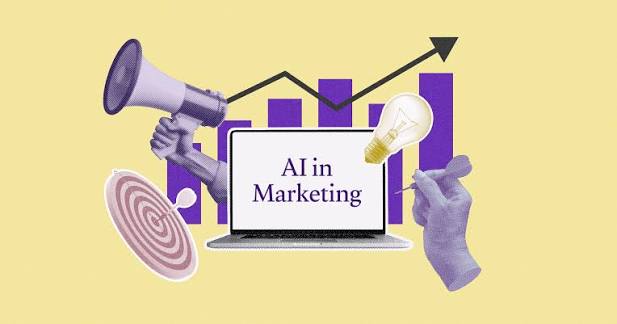
Artificial intelligence is no longer a concept belonging to science fiction or Silicon Valley boardrooms. It is inside the tools Nigerian business owners and marketers use every day — writing assistants, ad platforms, customer service software, email tools, design applications — and it is changing the rules of digital marketing faster than most people have had time to notice.
For Nigerian business owners, this shift presents two possible outcomes: those who understand what AI means for their marketing will gain a significant and compounding advantage over those who don’t. Those who ignore it — or misunderstand it — will find themselves paying more for less, falling further behind competitors, and struggling to understand why their marketing is becoming less effective even as they work harder at it.
This article is a plain-language guide to what AI is actually doing to digital marketing, what it means for your business specifically, and how to position yourself on the right side of this shift.
What AI Is Actually Doing in Marketing Right Now
Artificial intelligence in marketing is not one thing. It is a collection of capabilities — some dramatic, some subtle — that are quietly reshaping how businesses attract, engage, and convert customers.
Here is what is actually happening, in concrete terms.
Ad platforms are becoming smarter — and more demanding of quality input. Facebook, Instagram, and Google have been using machine learning to optimise ad delivery for years. But the sophistication of these systems has increased dramatically. Today’s platforms can identify, with remarkable accuracy, which users are most likely to convert — but only when the inputs they receive are strong. A weak offer, vague targeting, or poor creative limits what the algorithm can do. A clear offer, a specific audience, and compelling creative gives the algorithm the signal it needs to find the right people efficiently. AI has not made targeting less important. It has made the quality of your offer and creative more important than it has ever been.
Content creation has been democratised — and that creates a new problem. AI writing tools have made it possible for anyone to produce content at scale. Blog posts, social captions, email newsletters, ad copy — all of it can be generated in minutes. This sounds like good news, and in some ways it is. But it also means the internet is filling rapidly with generic, undifferentiated content that nobody asked for and nobody needs. The bar for what constitutes genuinely useful, distinctive content has risen sharply. In a world where average content is effortless to produce, remarkable content is what stands out — and remarkable content still requires human expertise, specific experience, and a genuine point of view.
Customer behaviour analysis has become more precise. AI tools can now analyse customer data at a level of detail and speed that was previously impossible without an enterprise-level research team. Which customers are most likely to buy again? Which leads are most likely to convert? Which content drives the highest-value enquiries? These questions can be answered with data, in real time, by tools that are increasingly accessible to businesses of all sizes. Nigerian businesses that learn to ask these questions — and use the answers to sharpen their marketing — will make decisions that competitors flying blind cannot match.
Personalisation at scale is now possible. For years, personalised marketing — the kind that feels like it was designed specifically for the individual receiving it — was the exclusive domain of large businesses with sophisticated CRM systems and data teams. AI has changed that. Email platforms can now personalise content dynamically based on subscriber behaviour. Ad platforms can deliver different creative to different audience segments automatically. Chatbots can handle initial client enquiries with responses tailored to the specific question asked. The businesses that use these capabilities effectively will build stronger client relationships at lower cost than those that don’t.
What AI Cannot Do — and Why That Matters
In the midst of the justified excitement about AI’s capabilities, a dangerous misconception has taken hold: that AI can replace the strategic and creative thinking at the heart of effective marketing.
It cannot. And understanding why is important for any Nigerian business owner navigating this landscape.
AI tools are pattern-recognition systems. They are extraordinarily good at identifying patterns in existing data and generating outputs that match those patterns. This makes them excellent at producing content that sounds like marketing — fluent, grammatically correct, structured appropriately — but it does not make them good at producing marketing that works.
Effective marketing requires things AI cannot supply. A genuine understanding of your specific client — their particular frustrations, their specific context, the precise language they use to describe their problem. A real point of view on your industry, developed through actual experience of what works and what doesn’t. The judgment to know which insight is worth leading with and which is better left unsaid. The creativity to find an angle nobody has found before.
These things come from human expertise. AI can support and accelerate the work. It cannot replace the thinking that makes marketing distinctive, credible, and effective.
The Nigerian businesses that will win with AI are not the ones that hand their marketing over to it entirely. They are the ones that use it as a capable assistant — faster research, faster drafting, faster testing — while keeping the strategy, the voice, and the judgment firmly in human hands.
The Specific AI Tools That Are Most Relevant for Nigerian Business Owners
You do not need to become a technology expert to benefit from AI in your marketing. But you do need to know which tools are worth your attention and why.
For content creation and copywriting: Tools like ChatGPT, Claude, and Gemini can significantly accelerate the writing process — generating first drafts, suggesting headlines, repurposing existing content into different formats. They work best when given specific, detailed context: who the audience is, what the content needs to achieve, what tone is appropriate, and what specific angle to take. Used this way, they compress hours of work into minutes. Used without that context, they produce generic content that does nothing for your brand.
For ad creative and design: Tools like Canva’s AI features and Adobe Firefly are making it faster and cheaper to produce professional-quality visual assets. For Nigerian businesses that previously relied on expensive designers for every piece of creative, these tools meaningfully lower the barrier to producing consistent, on-brand visual content at volume.
For SEO and keyword research: Tools like Semrush, Ahrefs, and Surfer SEO use AI to analyse search data and identify content opportunities. For a Nigerian business trying to rank on Google, these tools can reveal exactly what potential clients are searching for, how competitive those searches are, and what a piece of content needs to include to rank well — turning SEO from guesswork into a data-driven process.
For customer communication and lead follow-up: AI-powered chatbots and automated messaging tools can handle initial enquiries, qualify leads, and ensure that no one who contacts your business falls through the cracks. For Nigerian businesses where slow follow-up is consistently one of the biggest revenue leaks, this is an immediately practical application.
For analytics and performance insight: Google Analytics 4 and Meta’s AI-driven reporting tools can surface insights about which content, which campaigns, and which audiences are driving real business results — insights that would previously have required a data analyst to uncover.
The Risk Nigerian Businesses Need to Be Aware Of
As AI tools become more widely used, a new form of commoditisation is emerging. Content that looks similar, sounds similar, and says similar things is proliferating across the internet — because it is all being generated by the same tools with the same default outputs.
For Nigerian businesses relying on content marketing to build trust and attract clients, this is a real threat. If your content is indistinguishable from the AI-generated content flooding your market, it provides no competitive advantage. It contributes to the noise rather than cutting through it.
The solution is not to avoid AI. It is to use it in a way that amplifies what is genuinely distinctive about your brand rather than averaging it out. Your specific client stories, your particular methodology, your honest point of view on your industry, your documented results — these are things AI cannot generate because they don’t exist anywhere in its training data. They exist only in your experience.
The businesses that win in an AI-saturated content environment are the ones that use AI to work faster while doubling down on the human elements that AI cannot replicate: specificity, genuine expertise, and a distinctive voice.
What This Means for Your Marketing Strategy Right Now
The practical implications of AI for a Nigerian business owner’s marketing strategy are more immediate than most people realise.
Your offer and your positioning matter more than ever. As AI makes content and advertising easier to produce, the differentiating factor is not who can produce the most content or run the most ads. It is who has the clearest, most compelling offer for the most precisely defined audience. Get that right, and the AI tools amplify it. Get it wrong, and they amplify noise.
Quality over quantity is now a competitive advantage, not just a preference. When everyone can produce average content at scale, producing genuinely excellent content at lower frequency is a differentiation strategy. One deeply researched, specifically targeted, beautifully written article will outperform twenty AI-generated pieces every time — in search rankings, in reader trust, and in lead generation.
Speed of execution has increased across the board. What used to take a week now takes a day. What used to take a day now takes an hour. This means the gap between a good strategy and a visible result has narrowed — but it also means that competitors are moving faster. The businesses that combine strong strategy with efficient AI-assisted execution will move at a speed that manual processes simply cannot match.
Data literacy is becoming a non-negotiable skill. AI tools generate more data than most businesses currently know how to use. The ability to read that data, draw the right conclusions, and make better decisions as a result is becoming a genuine competitive differentiator. You do not need to be a data scientist. But you do need to understand what your numbers mean and be willing to act on what they tell you.
The Bottom Line
Artificial intelligence is not coming to digital marketing. It is already here — inside the platforms you use, the tools your competitors are using, and the expectations your clients are forming about how businesses communicate with them.
For Nigerian business owners, the response to this shift is not fear or paralysis. It is informed, strategic adoption. Use the tools that make you faster and more effective. Maintain the human judgment, the specific expertise, and the distinctive voice that no tool can replicate. And keep your attention on the thing that AI cannot optimise for: a genuinely useful, genuinely distinctive business that creates real value for a specific type of client.
That is what marketing has always been about. AI has changed the tools. It has not changed the fundamentals.
At Dgazelle Digital, we build AI-informed marketing strategies for Nigerian businesses — using the best available tools to move faster and smarter, while keeping strategy and creativity where they belong: in human hands.
If you want to understand how to use AI to grow your business without losing what makes your brand distinctive, let’s have that conversation.